High-quality silicone-based paint. Waterproof, breathable, crack-resistant.
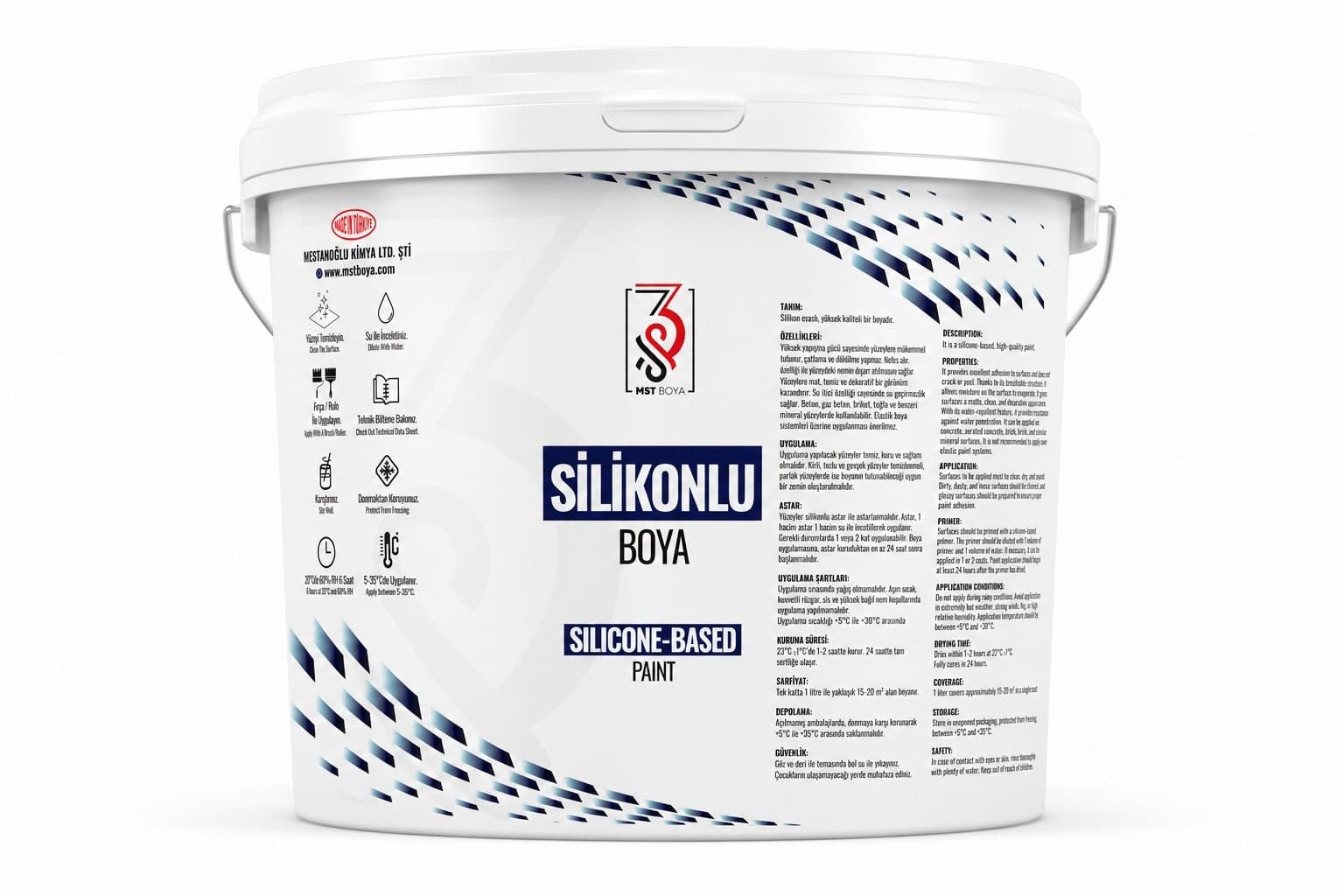
MST Silicone Paint is a high-performance, water-based facade paint containing silicone resin, developed for exterior use. It resolves the fundamental contradiction an exterior paint has to solve: the surface must not take in water from outside, yet must be able to release moisture from within.
Those two requirements are normally opposed. An impermeable film that stops water completely also traps the moisture inside the wall; trapped moisture expands in the first freeze–thaw cycle and lifts the paint off the surface. A breathable, porous film lets moisture out but also lets rainwater in. Silicone resin resolves the contradiction: it builds a structure that repels water at the surface while allowing water vapour to pass. Liquid rainwater beads up and runs off, while moisture in vapour form can escape.
A second consequence of that behaviour is self-cleaning. Water droplets that cannot cling to the surface carry dust and dirt down with them as they run. Silicone facades therefore stay looking clean longer than standard acrylic facades, and the difference is marked in areas with heavy urban pollution.
Crack resistance is the third advantage. A facade expands and contracts through the day and across the seasons. A film with low flexibility cannot follow that movement and develops hairline cracks, which open a direct path for water into the wall. The silicone structure lets the film accommodate thermal movement, reducing the risk of hairline cracking.
Typical applications include rendered and reinforced-concrete exterior surfaces, apartment and estate facades, villa and detached house exterior walls, topcoats over external insulation systems, restored building facades, and structures exposed to sea air and wind.
The surface must be clean, dry, sound and free of dust. On facade work this is the stage most often skimped and the most expensive to get wrong — correcting a surface after the scaffold is up costs many times more.
On an existing facade, scrape off blistered and loose paint and feather the edges. Remove moss, mould and algae growth with a suitable cleaner, rinse thoroughly and let the surface dry; if living organisms are left, they continue to grow beneath the paint film and lift it.
Assess the cracks. Hairline surface cracks can be filled with suitable material, but cracks caused by structural movement cannot be solved with paint and the cause must be addressed first. Defective joints, and water entry points at sills and window reveals, must be repaired before application — facade paint is not a waterproofing layer and cannot stop water entering through a detailing fault.
Absorbent render, new concrete and dusty surfaces must be treated with a facade primer. The primer binds a dusty surface and evens out absorption; even absorption prevents the difference in tone and sheen that is the most common defect on large elevations.
On facade work, planning errors outnumber technical ones. A facade surface must be finished without interruption. Returning to a half-dried area leaves a dark band at the lap, and on a facade that mark cannot be corrected once dry.
Work must be stopped at the natural break points of the elevation: building corners, downpipes, movement joints, balcony lines. If an elevation cannot be completed in one day, the break point must be decided in advance and work halted there.
Enough operatives must work simultaneously to keep a wet edge at all times. The first coat may be thinned with a little water according to absorbency; the second is applied unthinned or barely thinned.
Do not apply to a hot facade in direct sunlight; the surface dries early, the film does not form properly and adhesion suffers. Following the sun around the building and working on the shaded elevation is recommended.
Postpone if rain is expected; rain on a surface that has not completed film formation leaves permanent marks. Do not apply in strong wind or at low temperatures. Clean equipment with water.
The information below describes the general behaviour of silicone-resin exterior facade paints. For measured values specific to the product, refer to the technical data sheet (TDS).
| Property | General information |
|---|---|
| Product type | Silicone facade paint |
| Binder type | Silicone-resin modified acrylic |
| Use | Exterior facades |
| Key properties | Water repellent + water-vapour permeable |
| Additional properties | Self-cleaning, crack resistance |
| Application methods | Brush, roller, spray |
| Recommended coats | 2 coats over primer |
| Thinner | Water |
| Cleaning | Water |
There is a large difference in size between a droplet of liquid water and a molecule of water vapour. Silicone resin builds a surface structure that exploits that difference: liquid droplets cannot spread across the surface and instead bead up and run off, while much smaller vapour molecules pass through the film. The result is a facade that takes in no water from outside but can release moisture from within. The blistering and frost damage seen with impermeable films is largely prevented.
Droplets that cannot cling to the surface carry dust and dirt with them as they run off. This keeps the facade looking clean longer than standard acrylic paints, and the effect is most noticeable in areas with high urban pollution and dust loading.
Facade paint is not a waterproofing material. It cannot stop water entering through details such as sills, parapets, joints and window reveals; those points must be sealed separately. Cracks caused by structural movement cannot be bridged with paint. Surfaces under permanent water immersion, the earth-retaining face of basement walls and industrial floors are outside its scope. Do not apply over concrete or render that has not fully cured.
Store in the closed original container in a cool, dry place. Being water-based, protect from frost; do not use product that has frozen.