Silicone-acrylic copolymer emulsion based interior and exterior wall coating primer.
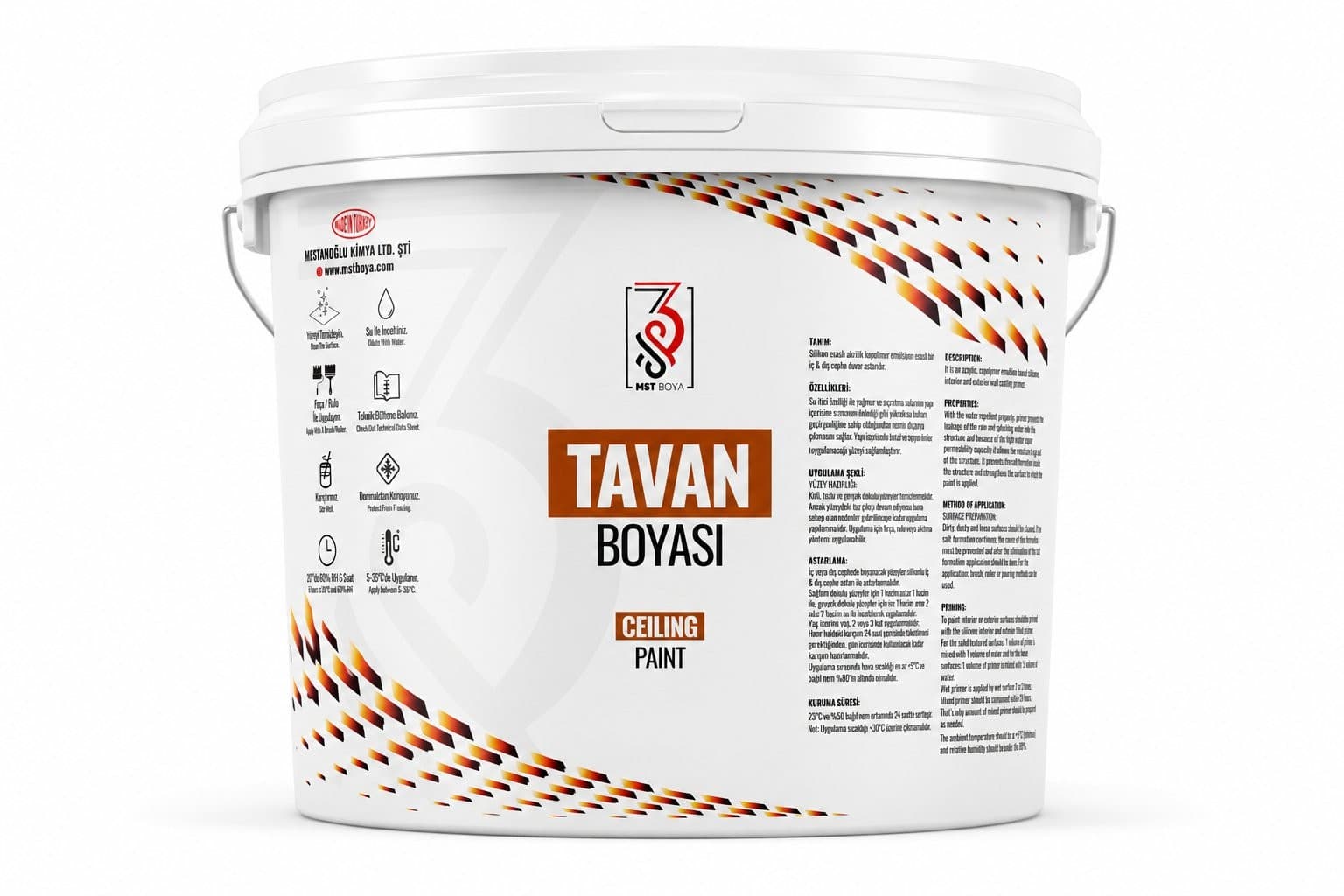
MST Ceiling Paint is a fully matt, water-based paint with high opacity, formulated specifically for ceilings. It is developed around the ways a ceiling behaves differently from a wall.
The ceiling is the hardest surface to paint, and not only because working overhead is awkward. Throughout the day a ceiling takes horizontal light from the windows at a grazing angle. At that angle the smallest surface defect, roller mark or difference in sheen becomes obvious; an irregularity that would never be noticed on a wall stands out immediately on a ceiling. That is why the critical property of ceiling paint is not colour but a fully matt finish. A matt surface reflects light diffusely, hides defects and makes the ceiling read as flat.
The second critical property is resistance to running. Paint applied to an inverted surface works against gravity; a product whose consistency is not right will drip from the roller and leave runs. Ceiling paints are therefore formulated at a higher viscosity — they stay on the roller, reduce dripping and cover better in a single coat.
The third is opacity. The problems most often met on ceilings are old water stains, soot marks and yellowing. High opacity means those marks are covered in fewer coats.
Typical applications include residential and office ceilings, plasterboard and suspended ceiling surfaces, rendered and concrete ceilings, corridor and stairwell ceilings, and the large ceiling areas of schools, hotels and hospitals.
On ceiling work, preparation takes longer than the application itself and decides the result. Empty the room as far as possible and cover remaining furniture and the floor; ceiling paint disperses as fine droplets over a wide area.
Remove dust and cobwebs from the surface, and clean grease deposits from kitchen ceilings with a suitable cleaner — paint will not bond to a greasy surface. Scrape off blistered and flaking old paint and feather the edges with abrasive. Fill cracks and holes with suitable filler, sand, and remove the dust.
The yellow-brown marks left by a water leak, along with soot and nicotine staining, will not be covered by ordinary paint; however many coats are applied, the stain works its way back through to the surface over time. These marks must first be sealed with a suitable stain-blocking primer, and the ceiling paint applied over it. Skip that step and the entire job returns within weeks.
New plaster, plasterboard and render are highly absorbent surfaces and must be primed. Without primer the first coat is absorbed, opacity falls, and the difference in absorption between plasterboard joints and open areas shows as a permanent variation in tone.
Cut in the corners and wall junctions with a brush first, then cover the open area with a roller. Do not overload the roller; take off the excess on the grid, because an overloaded roller drips.
Finish the ceiling in one uninterrupted session. Keep a wet edge and work in bands that overlap the previous one. Returning to a half-dried area leaves a permanent lap mark, and on a matt surface that mark cannot be corrected.
Keep the roller direction the same across the whole ceiling. Laying off the final passes at right angles to the window reduces the visibility of marks in grazing light.
Two coats are usual; more may be needed over a dark colour or a stained surface. Allow the surface to dry between coats.
Being water-based, drying depends on humidity and air movement. In very warm, dry conditions the surface dries early and keeping a wet edge becomes difficult. Excessive draught has the same effect; do not leave opposing windows open during application. Clean equipment with water.
The information below describes the general behaviour of water-based ceiling paints. For measured values specific to the product, refer to the technical data sheet (TDS).
| Property | General information |
|---|---|
| Product type | Ceiling paint |
| Binder type | Water-based (acrylic / vinyl) |
| Appearance | Fully matt |
| Key properties | High opacity, resistance to running |
| Application methods | Roller (preferred), brush, spray |
| Recommended coats | 2 coats over primer |
| Thinner | Water |
| Cleaning | Water |
| Odour | Low |
Because a ceiling receives window light at a grazing angle, surface defects become pronounced at that angle. Gloss and mid-sheen surfaces reflect light directionally and make every mark visible. A fully matt surface reflects light diffusely, concealing roller marks and small irregularities. On a ceiling, a matt finish is a functional requirement rather than an aesthetic preference.
Paint working on an inverted surface has to resist gravity. Ceiling paints are therefore formulated at a higher viscosity than wall paints; they hold on the roller, reduce dripping and cover better in one coat. Thinning this product with more water than necessary destroys that property and causes dripping.
In wet-room ceilings and areas with persistent condensation, moisture-resistant products should be considered. Stains caused by a water leak must not be covered before the leak itself is fixed and a stain-blocking primer applied — otherwise the stain returns. Do not apply over fresh render that has not fully cured.
Store in the closed original container in a cool, dry place. Being water-based, protect from frost; do not use product that has frozen.